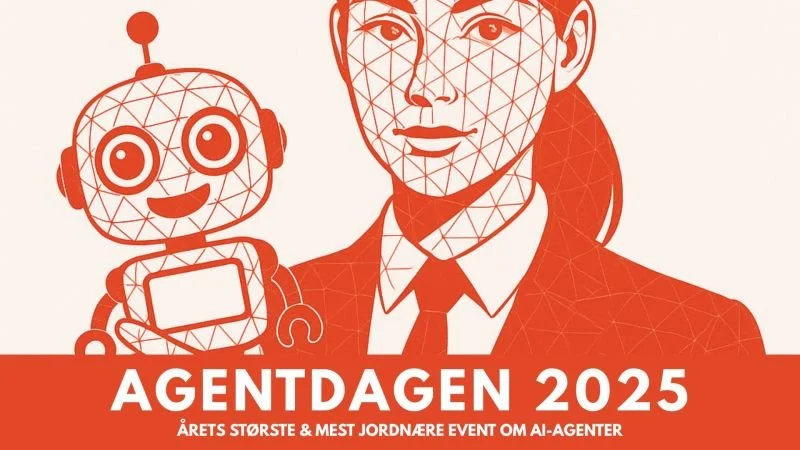
Denmark is leading the world in AI adoption. At AGENTDAGEN 2025, it was announced that 42% of Danish enterprises are now using AI technologies, up from 28% in 2024. This puts us ahead globally, but with that position comes responsibility. The EU AI Act will play a major role in how we foster safe and sustainable AI adoption across industries.
I attended AGENTDAGEN to better understand how we, at Horaizon, can stay at the forefront of this evolution – and where we can help clients build AI agents that do real work, not just produce outputs. Below are some of my key takeaways from the day:
[01]
"Don't focus on automation – focus on goal-directed adaptive behaviour."
A standout quote from Daniel Hulme (WPP), whose talk was packed with insight. He walked us through:
The 6 applications of AI
- Task automation
- Content Generation
- Human Representation
- Insight Extraction
- Complex Decisions
- Human Augmentation
The 5 levels of verification
- L1: dialogue-based to test for knowledge
- L2: dialogue and scenarios to test for skills
- L3: complex scenario to test for expertise
- L4: tests for intelligence/plasticity
- L5: tests for consciousness
The 6 AI singularities
- Political: When we no longer know what is true
- Environmental: When we create uncontrollable ecological collapse
- Social: When we cure death
- Technological: When we create a superintelligence
- Legal: When surveillance becomes ubiquitous
- Economic: When we automate the majority of paid labour
It was a masterclass in shifting the conversation away from AI as a productivity booster toward AI as an adaptive agent aligned with outcomes.
Oh — and his ideas on "curing death"? Let's just say the room was very engaged.
[02]
Testing is the value bottleneck
Daniel also mentioned that 80% of software deployment costs are in testing — and this couldn't ring truer. At Horaizon, we've seen time and again that the most challenging part of delivering robust AI products isn't building the prototype – it's validating edge cases, reranking responses, managing risk, and testing in the real world.
[03]
You can't differentiate with generic models
One quote from the "Giant's Panel" – featuring leaders from Microsoft, SAP, IBM, Adobe, and Meta – really stuck with me:
“"You don't achieve competitive differentiation with a generic model." – Thomas Kovsted (CEO of IBM Danmark)”
This reflects a core belief at Horaizon: it's not enough to plug into GPT-4 and call it innovation. The real value is in building purpose-driven agents tailored to specific workflows, data contexts, and user needs.
[04]
AI compliance isn't optional
CLEMENS made the point clear: leadership can no longer ignore the compliance implications of AI. That's why we're proud to be partnering with Sarah Jakobsen at RiskEnable, working on an end-to-end AI Compliance Hub — helping organisations innovate responsibly under the coming EU AI Act.
[05]
Real-world use cases are maturing
Pernille Bernth from Fellowmind shared a compelling breakdown of agent-assisted workflows in customer service. By dividing tasks into AI-assisted and automated, it became clear that we're entering a phase where more and more tasks will migrate toward full automation.
This echoes what we're building with clients – helping teams gradually hand off tasks to intelligent agents in a controlled, value-driven way.
[06]
SEO is becoming GEO
Adobe's Jo O'Connor shared a marketing insight that stopped me in my tracks: the future isn't Search Engine Optimisation (SEO) — it's Generative Engine Optimisation (GEO).
As users turn to LLMs like ChatGPT and Claude for product searches, we'll need to rethink how businesses show up in AI-generated answers. A whole new field is emerging — and it's one I'll be keeping a close eye on.